Boston Metro Area, Massachusetts
 |
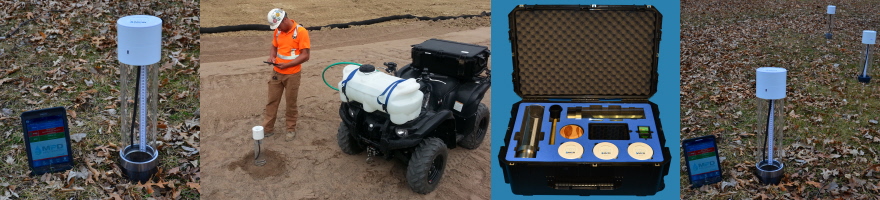
In 2025, engineering firm Woodard & Curran chose the MPD Infiltrometer to conduct infiltration rate
testing for a municipality in the Charles River watershed. The Charles River watershed communities
face increasing regulatory requirements driving action around the planning, design and implementation
of new stormwater controls. In some cases, municipalities could be facing hundreds of millions of dollars
for new stormwater control measures (SCMs). While many communities have existing controls, many of these
are undermaintained or were not specifically designed for nutrient control.
Over the course of a few days, Woodard & Curran technicians evaluated nine existing SCMs for performance,
using the MPD Infiltrometer for infiltration rate testing. The results showed that some SCMs performed better
than designed, allowing the community to claim more nutrient reduction credit and saving them hundreds of
thousands of dollars in capital investment offsets. Other SCMs were identified as needing immediate
maintenance and some were tagged for simple retrofit options to improve performance.
The Woodard & Curran technicians shared that the portability, speed and small volume of water needed using
the MPD Infiltrometer made these field investigations easier than traditional methods. Upstream is proud to
have been a partner in this project, which embodies one of our core goals: improving efficiency and lowering
costs in the stormwater industry.
|
|
MPD Documents
MPD Login
MPD Borehole
MPD Brochure (PDF)
MPD Borehole Brochure (PDF)
Sample MPD Report
MPD Demonstration Video
MPD App Guide
What's included with each MPD kit?
MPD PRICING
GUARANTEE
Build America Buy America Certificate(PDF)
Technical
ASTM STANDARD D8152
What is Ksat? (PDF)
MPD - Double Ring Comparison (PDF)
MPD Accuracy (PDF)
MPD Explained (PDF)
Research Papers
MPD performance vs other methods (PDF)
MPD Saturated Conductivity Surface Soil (PDF)
Field Infiltration Measurement (PDF)
Math used to calculate site wide weighted average of multiple MPD tests across a site
CIP for Infiltration
Capital Improvement Planning
for Infiltration BMP's (video)
Municipalities using the MPD
ASTM Standard D8152 defines the methodology for performing a manual MPD test. This method is in the Public Domain.
Upstream Technologies has automated this ASTM standard allowing anyone to perform this test.
Upstream Technogies has patented this automation.
U.S. Patent #10,739,242
Engineers
Use the MPD infiltrometer to provide a site-specific Ksat for design of infiltration practices.
No more relying on vague ranges provided by soil surveys! Also use it to quickly verify the construction
of these practices before authorizing payment to the contractor.
Public Works
Perform annual Ksat tests on all of your agencies rain gardens, infiltration basins, and swales.
Easily monitor any changes in infiltration capability over time.
History
The MPD methodology and calculations have a long history dating back to 1911 with the
Green-Ampt theory for estimating infiltration, which incorporates many variables that other methods,
such as Darcy's Law, do not. Some of these variables include: Soil Suction Head, Porosity, Hydraulic Conductivity and Time.
Two men, Philip & Dunne, then furthered this research and developed a methodology that incorporated the
use of a cylinder, filled with water and measured head drop over time. The subsequent math equations incorporate the
Green-Ampt theory
to predict the field saturated (or steady state) infiltration rate, also known as Hydraulic Conductivity.
Philip and Dunne published their methodology in 1993 for peer review.
The University of Minnesota modified Philip & Dunne's work with a variation to the equation in 2007,
renaming the method: Modified Philip Dunne or (MPD). This method has been peer reviewed and
vetted in the world-wide academic and scientific communities since 2007, becoming an
ASTM STANDARD D8152 in 2018.
See Google Search
|
|
© Copyright 2021 Upstream Technologies
|
HOME
PRODUCTS
VIDEOS
PRICING
ABOUT US
CONTACT
|
SAFL Baffle: U.S. Patents: #8715507B2, #8663466B2, #9506237B2, CANADA Patent: #2742207
SKUNK Garbage Trap: U.S. Patent #10,408,242
Automated MPD Infiltrometer: U.S. Patent #10,739,242
|
|
|